Civic Place

info@CivicPlace.co.uk

  • Home
  • Our model
    • How it works
    • Planning
    • Risk
  • For councils
    • Value Proposition
    • Funding
    • Questions Councils Ask
  • About us
    • Our Leadership
    • Our Partners
  • Contact us
    • Get In Touch
  • More
    • Home
    • Our model
      • How it works
      • Planning
      • Risk
    • For councils
      • Value Proposition
      • Funding
      • Questions Councils Ask
    • About us
      • Our Leadership
      • Our Partners
    • Contact us
      • Get In Touch

info@CivicPlace.co.uk

Civic Place
  • Home
  • Our model
    • How it works
    • Planning
    • Risk
  • For councils
    • Value Proposition
    • Funding
    • Questions Councils Ask
  • About us
    • Our Leadership
    • Our Partners
  • Contact us
    • Get In Touch

Affordable homes on council land, with no capital and no development risk

Civic Place gives councils a way to turn underused land into affordable and social rent homes without borrowing, spending capital or carrying development risk. The council keeps the freehold, nominates the tenants and receives a cash share of the surplus.


What the council gets
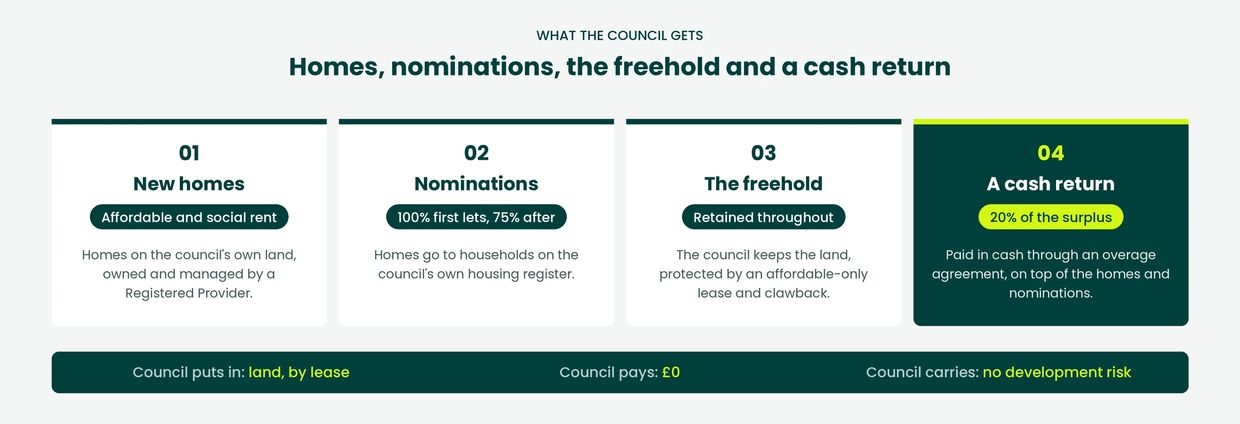
Homes, nominations, the freehold and a cash return, at no cost to the council

  • The council receives new affordable and social rent homes on its own land, 100% of first lets and 75% thereafter from its housing register, the freehold retained throughout, and 20% of the scheme surplus paid in cash through an overage agreement. 
  • In return it pays nothing. All planning, design, survey, construction and finance costs are met by Civic Place and its partners. Cost overruns and programme delays sit with us, and no council capital, borrowing or guarantees are required. 

Protecting the council’s land

The land can only ever be used for affordable housing


  • User restriction. The lease restricts use to affordable housing only.
  • Affordable-only consent. Planning permission is sought for affordable housing only, so the scheme cannot switch to market sale.
  • Clawback. If no planning application is submitted within 12 months, or the lease terms are breached, the land returns to the council.

WHO OWNS THE HOMES

A Registered Provider owns and manages the homes for the long term

  • At practical completion the homes pass to a Registered Provider, regulated by the Regulator of Social Housing. 
  • It owns, lets and manages them, and lets them to households from the council's register under a nominations agreement: 100% of first lets and 75% thereafter.  
  • The council carries no management, maintenance or stock liability. 
  • Where the council already works with a preferred Registered Provider, we are happy to discuss involving them. 

Why it matters now

Every permanent home reduces pressure on temporary accommodation 

Councils in England spent £2.93bn on temporary accommodation in 2025/26 (MHCLG, 2026), and 135,580 households were living in it in March 2026 (MHCLG, 2026). 


Every household housed through council nominations into a permanent affordable home is one fewer relying on costly nightly paid accommodation. 


Where it works best

Sites where a sale would bring in little 

The model works best where the council holds land with modest disposal value. Keeping the freehold costs the council almost nothing, and homes on the site deliver far more value than a one-off receipt. Typical sites include surplus depots, car parks, garage blocks and infill plots. 


See the whole model on one page


Download the summary

Civic Place Ltd. Registered in England and Wales, company number 17043041. Registered office: 128 City Road, London, EC1V 2NX.

  • Privacy Policy

This website uses cookies.

We use cookies to analyze website traffic and optimize your website experience. By accepting our use of cookies, your data will be aggregated with all other user data.

DeclineAccept